07 August 2011

Nurnberg, Germany: A Cute Little City

One of the first things we found in this delightful little town was delicious German food!  We both had local specialties (and local beer!).

Nurnberg, an old walled city whose castle dates from the 13th century, is probably most famous for the post-WWII trials.  However, unbeknownst to me until today, having the trials in Nurnberg was not a mistake; there is a colossal hall here that Hitler used to use for rallies, so the Allies though it was 'poetic justice' to have the trials in the same location.  In either case, the city still retains much of its old Bavarian charm, with many pretty buildings, roads, and squares.


As is requisite for any castle city, we climbed the hill, and wandered around the gardens and bastions.  Behind us you can see a view of Nurnberg from one of the castle walls--it was one of the 'high points' of our day :-)

06 August 2011

Heidelberg, Germany: Kathryn is Here!

Kathryn arrived in Frankfurt today!  This is us as we are leaving the Frankfurt airport, headed to Heidelberg (it was Kathryn's first long-distance train ride!), for the start of our European adventure.

This is a view of the rooftops in the Old Town of Heidelberg with the Schloss Heidelberg (literally translates to Castle Heidelberg).  We climbed the hill (the very, very steep hill) to the castle and meandered about in the ruins.

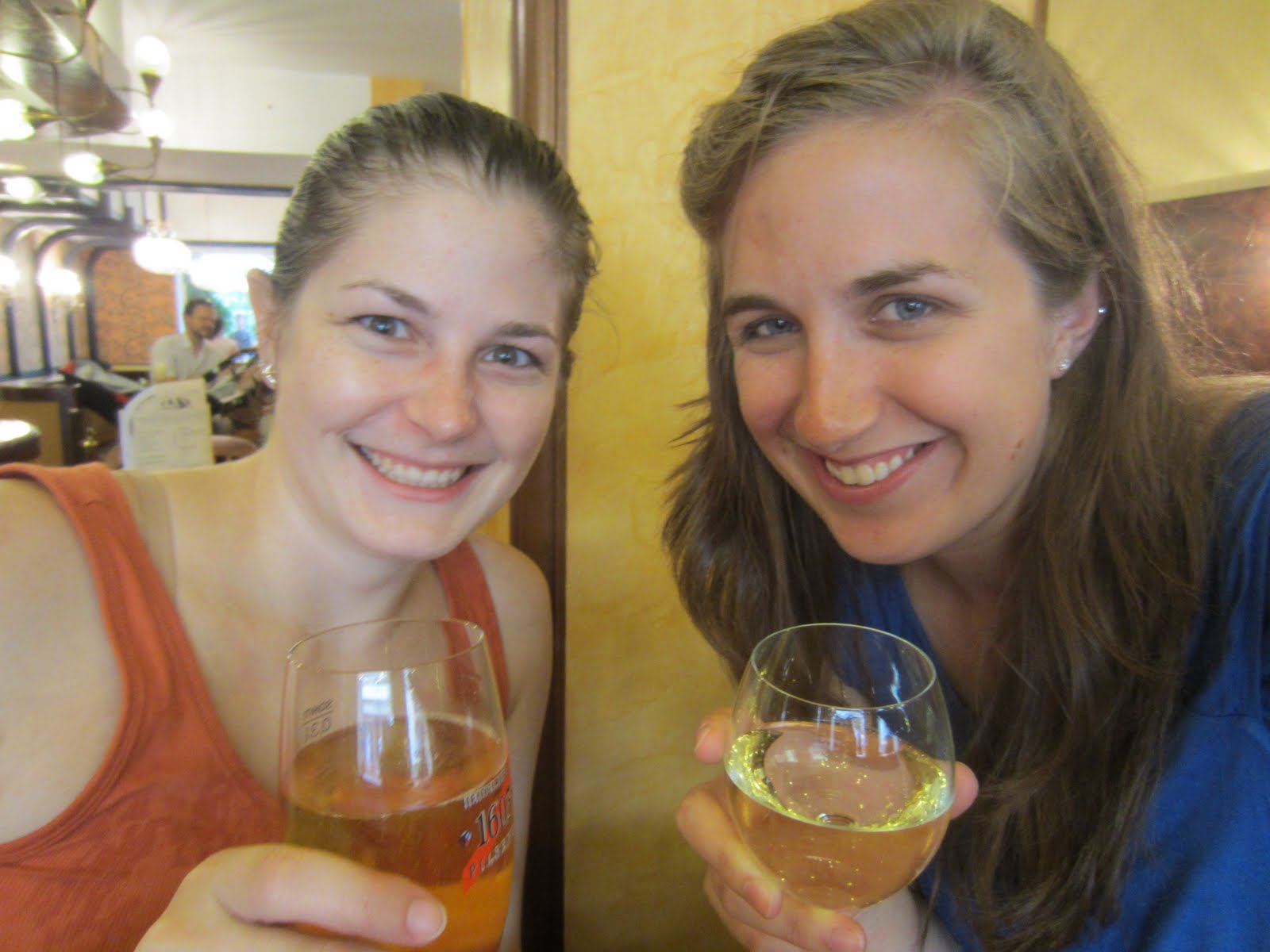
Despite the pleasant temperatures, we did encounter periodic torrential rainfall.  And what better way to escape the rain than with a delicious Heidelberg beverage?  Local beer and wine were our choices, along with some traditional German food--a great start to our European culinary tour!

05 August 2011

Frankfurt, Germany: Relaxation and Old Friends

Today was a wonderfully relaxing day in Frankfurt: reading, catching up on email, doing laundry, and more of the like.  After this much-needed break, I met up with Katrin (an exchange-student friend from high school), and we had a lovely dinner and walk around the city.  Behind us is the skyline of Frankfurt's financial district, known as Main-hattan (it's on the river Main) or Europe's New York.  It was great to catch up with Katrin, meander around the city, and actually be chilly...what a perfect evening!


04 August 2011

Oswiecim, Poland: Auschwitz-Birkenau

These are the first words you see as you walk into the largest concentration and extermination camp of World War II, and they were an excellent frame for my day.  Standing in the place where so many atrocities were committed, reliving that sordid bit of history, and getting minute details about these camps that I was not aware of can not be called pleasant, but was certainly moving, sobering, and a lesson in what bias and power can cause.  Since I'm sure you all know the general history of these two camps, I will just pull out a few details to go with some of my most poignant shots.
These cans contained Cyclone 5, which is a crystalline form of cyanide gas that evaporates at 27C.  It was this gas that was used in the gas chambers at Auschwitz and Birkenau, which is also know as Auschwitz II.  To put in in perspective...each one of the cans above contained enough Cyclone 5 to kill between 1500-2000 people.  (As a measure of the size and scope of these camps, 1.3 million people were killed here between 1940-1944, 1.1 million of whom were Jews, with the remainder being Poles, Roma (the gypsies), Soviet soldiers, and other 'enemies of the Third Reich'.  Most of the Jews sent to these camps were from Poland.  Poland alone had 3.5 million Jews living in it before 1939, and in 1947, there were only 12,000, thanks in large part to Auschwitz/Birkenau.)

When they arrived at the camps, the Jews--most of whom were there because they had been told that they were going to a good factory job--were separated in to groups of men fit to work, men not fit to work, women, and children.  They were then stripped of all their belongings, and sent either the gas chambers (all men not fit to work and most children were sent here immediately), the barracks, or the work camp.  The display above contains 40,000 pairs of shoes that were found after the liberation, roughly 5% of the shoes of the people who came through these camps.  Another display that I feel bound to comment on, though we weren't allowed to take pictures, is a case containing seven metric tons of human hair.  The Germans didn't like to waste things...so they would force the Jews who were working in these camps to shave the heads of the Jews who were exterminated in the gas chambers, and the Germans would export the hair to the mainland to be made into tapestries and sewn as lining into the German soldiers' uniforms.  The hair in the display was found in bales when Auschwitz was liberated.

This was the 'pilot' gas chamber at Auschwitz, where the Nazis tested and perfected extermination by gas.  In this chamber, which was roughly 40' by 40', 1000 people would be crammed and killed at a time.  After the process was finalized, all gas exterminations were carried out at Birkenau, where there were four such chambers.
These are the reconstructed barracks at Birkenau, which are likely recognizable from oft-reproduced photographs of the camp.  The Germans burned the originals barracks before the liberation to destroy the evidence, but the reconstructions are still very harrowing.  Though learning all this definitely made it a hard day, I would recommend going to the camps--most of the details I shared above were conveniently omitted from the history books that I have read, and getting the 'real story', so to speak, makes one think about what let to this genocide...and how to recognize the signs and stop it in the future.

03 August 2011

Krakow, Poland: Safe Travels, Janine!

On our last day in Poland, we explored Wawel Hill and castle.  The shot above is of the wall and tower on the south end of the complex.  Because this was a general's seat in both World Wars, the hill, castle, and cathedral escaped virtually unscathed, making it an excellent example of medieval architecture (built in the 14th century) and the place with the oldest original buildings in Poland.

The cathedral on Wawel Hill is known as the Royal Cathedral, and many ancient Polish kings, generals, and bishops are buried in its crypts, as well as the president and his wife who were killed in an airplane crash a couple of years ago.  We took a tour of the cathedral with a knowledgeable young Polish guy who explained all the tombs, history, and chapels, which turned out to be an excellent idea because--if you couldn't guess from the picture above--the cathedral didn't really have a unifying theme, and was basically continually added on to for a couple of centuries...it would've been very confusing on our own!

After Wawel Hill, we explored St. Mary's Cathedral, which is on the main square and whose towers can be seen in the center of the picture above.  This church had a LOT going on, but the center, a beautiful 15th century wooden triptych, was spectacular.  This cathedral is the seat of the Archdiocese of Krakow, so it was the cathedral at which PJPII was Archbishop before becoming pope, so that added a special dimension to my visit.  After a late lunch on the square, it was time for a nap and a wander around the Jewish Quarter...and thus ends my time in Poland, and Janine's time in Europe.  A big thank you to her for an amazing month of new experiences!

02 August 2011

Krakow, Poland: We Love Poland

Today, the plan was to journey from Warsaw to Krakow in the morning, then explore Krakow in the afternoon.  The journey occurred (thanks largely to one very helpful Polish man), but--due to incorrect scheduling and a delayed train--we didn't actually get to Krakow until late afternoon, hence me sitting on my backpack at the train station for three hours (see above).  At least it was nice and cool!

The shot above really doesn't do it justice, as I took it from a moving train, but the Polish countryside was really beautiful, with lots of small, well-kept farms and cute little houses.

The main square of the Old Town is Europe's largest medieval square, measuring 200m by 200m.  It is quite beautiful by night, as all the buildings and towers are well-lit, and there are street performers and people out in droves (and it's actually dark by 9:30, something we haven't experienced in quite some time).  I can't wait to start exploring Krakow in more depth tomorrow!

01 August 2011

Warsaw, Poland: The 67th Anniversary of the Warsaw Rising

Today was an absolutely amazing day.  By a happy accident, I happened to spend my day in Warsaw on the 67th anniversary of the Warsaw Rising.  For those of you who don't know what that is, I didn't either, which is why my first stop was the Warsaw Rising Museum.  In brief, here's what happened: Nazis occupied Warsaw on September 1, 1939 (the city had a population of 1.3 million at that time).  By 1944, the population had dropped to 900,000 (as a result of extermination of Jews and exportation of Poles to labor camps), and--facing Soviet occupation from the east--the Polish underground army organized an uprising.  Scheduled to begin at 17:00 on August 1, the uprising lasted for nearly two months, during which 15,000 Polish soldiers and 180,000 civilians were killed (including a hospital of 300 injured people that were shot by German troops).  Despite the fact that the Poles were fighting on the side of the Allies, no press coverage or aid was given by Britain, the US, or the Soviets.  The Rising was finally crushed when German troops air bombed the entire city, effectively razing it to the ground.  By January 1945, as a result of extermination by Germans, starvation, or exportation to labor camps in Germany or Russia, the population of Warsaw was reduced to a mere 1000.

As if the story above wasn't bad enough, once the Soviets gained control of eastern Poland, they made it illegal to teach about, talk about, or write about the Warsaw Rising, and spread propaganda that it was in fact the Soviets who had put up resistance in Warsaw.  It wasn't until Pope John Paul II's first papal visit to Poland, during which he discussed the Warsaw Rising in a homily, that the Poles began to investigate their lost history.  Today, on the main square in the Old Town of Warsaw, on the 67th anniversary of the Warsaw Rising, you can see the thousands of people assembled standing still and facing west for a minute of silence, commemorating the people who lost their lives in the Rising.  This minute of silence occurred exactly at 17:00--the same time the rising began 67 years ago.

After watching the assembly in the main square, I walked around the Old Town, and on street corners everywhere there were groups of people singing traditional Polish songs.  Sometimes there were instruments, sometimes not; sometimes song sheets, sometimes not; but always, always, people were full of joy and pride in their country--enough for men and women and young and old to gather together and sing on street corners.  It was a nationalistic pride unlike anything I have ever seen, bar none.

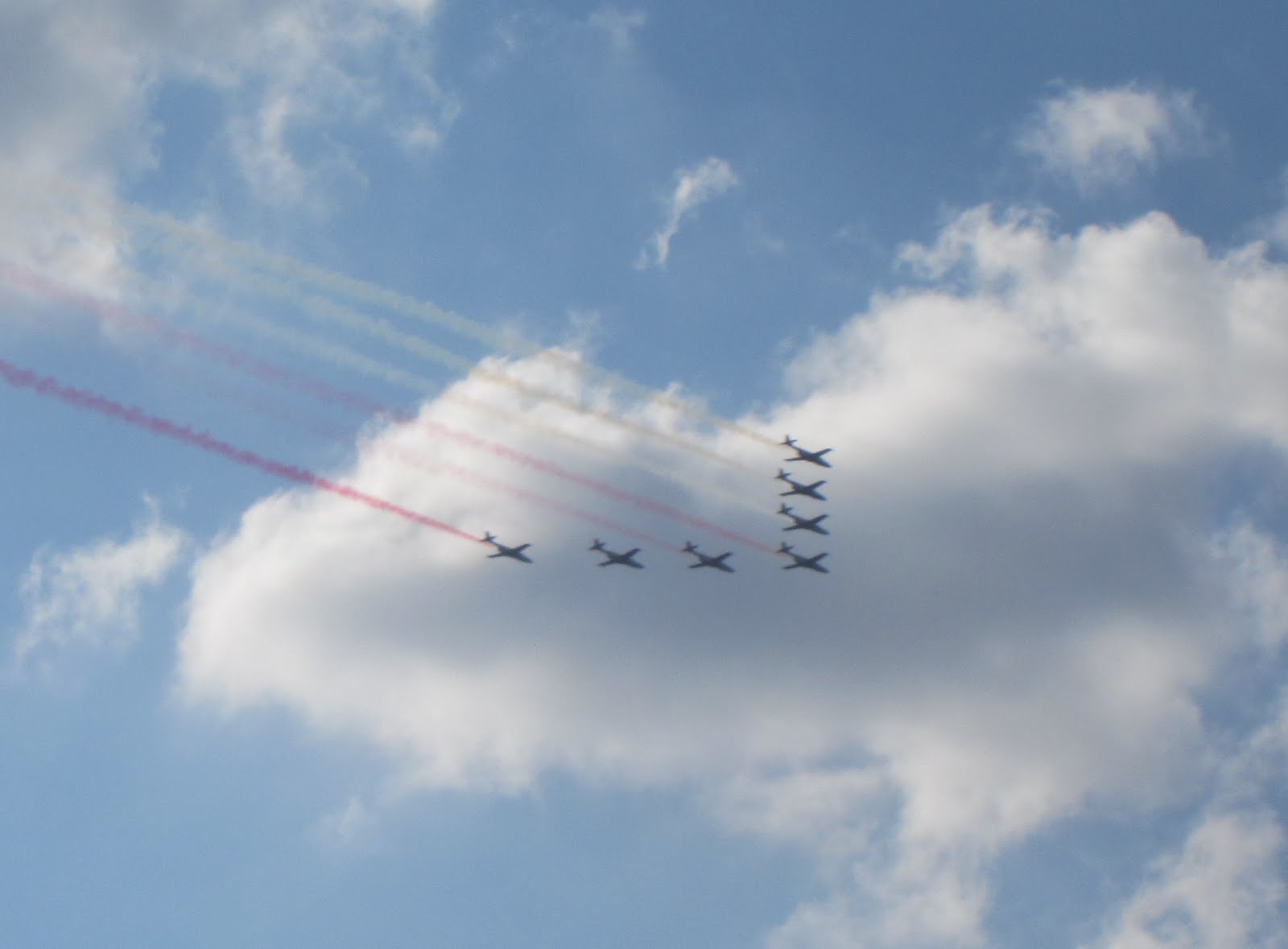
This is a bit out of order, but after the moment of silence at 17:00, there was a flyover by these jets, and there were positioned such that their exhaust painted the Polish flag across the sky.  It literally brought tears to people's eyes in the square.  Though the Warsaw Rising was a tragic chapter in Poland's history, I am so glad I got to be here for its commemoration.  I feel like I got a view of the Polish people and culture that I would be hard-pressed to get in any other way.  Definitely one of the best days yet!